Coronavirus and the spectre of the closed network

How will the world be reshaped by coronavirus? Answers to this question have almost become a genre unto themselves. Such speculation – even if it is just speculation – can be valuable, and not just insofar as it helps us to grapple with the particular threat facing us. Moments of unexpected shock like this one, when drastic change suddenly seems possible, can shake us out of our engrained ways of thinking and refocus our attention on the forces at play in our lives.

To be sure, the arrival of a global pandemic has not escaped the immense gravitational force of familiar arguments. Many conservative commentators have taken it as confirmation of long-held suspicions over globalisation: a pathogen bred in unhygienic Chinese animal markets seems an obvious reminder that bad things as well as good can spread through porous borders. There is, moreover, nothing quite like the prospect of collapsing supply chains to stir vague longings for autarchy. “If Britain were ever isolated from the rest of the world,” a columnist in the UK’s Telegraph opines, “It would need healthy farms.”

No more surprising have been the efforts to redirect discussion of the virus towards issues of prejudice and discrimination. The most cartoonish illustration of this remains the statement of the World Health Organisation director general that “The greatest enemy we face is not the virus itself; it’s the stigma that turns us against each other.”

Neither of these responses are entirely without merit, of course, but they are illustrative of the overly simplistic way we have come to think about the interconnected world in which we live. In the western democracies, a decade of political trench warfare over issues of national sovereignty, immigration and the domestic consequences of a globalised economy has led us to reduce the complex reality of networks and connectivity to questions about openness.

How should we weight the benefits of mobility and change versus those of stability? How flexible should our culture be? What responsibilities do we have towards the rest of the world? Should we be “somewheres” or “anywheres”? These are important questions, but they have absorbed our attention to the extent that we have not kept track of the conditions which allowed them to be posed in the first place. They seem to assume that a capacity for an ever-increasing interconnectedness is like an escalator towards an ever more open and fluid world; our decision is merely whether or not we should step onto it.

All the while, however, a different story has been emerging under our noses. Those very debates about the merits of openness have been facilitated by a boom of network technology, and this has itself brought about new kinds and degrees of fragmentation and mistrust. The division fuelled by social media, the cultural isolation manifest in personalised algorithms, the capture of audiences through disinformation and propaganda – these are only the most visible symptoms of that paradox.

Since the 1980s, the emergence of the so-called knowledge economy – where patents and other intellectual property are increasingly reliant on the management and analysis of vast seas of information, made available through connectivity – has exacerbated the social, cultural and economic decoupling of wealthy urban centres from resentful heartlands. As the economist Paul Krugman noted in a recent interview, the internet has made it possible for firms “to actually separate the low value activities from the high value activities, so that your back office operations can be some place where land is cheap and wages are low, but you can keep your corporate headquarters and your high-level technical staff in lower Manhattan.”

The coronavirus’ disruption of our habitual social and economic interactions has led to a dawning realisation that we have already adopted a suite of technologies with immense potential for social fragmentation. In The Atlantic, Ian Bogost points out that the infrastructure already exists for a privileged section of society to retreat into a virtual enclave of remote work, shopping, education and entertainment. Quarantine, he writes, “is just a raw, surprising name for the condition that computer technologies have brought about over the last two decades: making almost everything possible from the quiet isolation of a desk or chair illuminated by an internet-connected laptop or tablet.”

Similarly, much of the cosmopolitanism that exists in our societies today – and which is also centred in the hubs of the knowledge economy – has stemmed from the incentives for migration produced by an abundance of service sector jobs. These, too, could be made redundant by a greater leveraging of connectivity. As Ed Conway recently speculated in the London Times, the coronavirus shock could help to stimulate “a new model of globalization,” based on technologies such as 3D printing, artificial intelligence and robotics. This would allow labour and resources from around the world to be coordinated more efficiently, thereby reducing the unreliability which comes from actual people and things having to be in certain places at certain times. Conway asks us to imagine “hotel rooms in London being cleaned by robots controlled by cleaners in Poland, or lawns in Texas mowed by robots steered by gardeners in Mexico.”

Now, I have no idea whether coronavirus will launch a fourth industrial revolution, or hasten our evolution into housebound recluses sustained by Netflix, Amazon and telecommuting software. My point is this: connectivity does not exist on a simple scale of more and less, and nor does it axiomatically entail a high degree of openness. Rather, connectivity can come in many forms, and the world can continue to become more densely interconnected without any concomitant increase in the freedom or willingness to interact.

The implications of this reality do not favour communitarian “somewheres” any more than the liberal “anywheres,” to return to our troublesome dichotomy. For it means that we can have all the alienating effects of connectivity with none of the benefits. One can easily imagine an expansive network capable of harvesting huge amounts of information, and of coordinating vast resources, but where the majority of people who provide the inputs remain in many respects isolated, with limited ability to use the network for their own ends. They would be “connected,” but as mere nodes, not as agents. The obvious precedent here is China, where technology has enabled a previously unimaginable degree of surveillance and social control, including control over the circulation of information.

We can, of course, still argue about whether we should try to bring about a more cosmopolitan world. But the possibilities raised by coronavirus should, at the very least, drive home the realisation that networks cannot simply be presumed to facilitate the politics of openness. G.W.F Hegel famously said that the owl of Minerva takes flight at dusk, and we have been proving him correct by arguing over a world on which the sun is already setting.

The end of extraordinary politics?

I’ve been overseas for a few weeks, so I missed the election results coming in on December 12th, and most of the ensuing media frenzy. Based on the odd headline I did see, it seemed as though the British political system had just been administered an enormous quantity of laxative; though whether Boris Johnson’s breaking of three years of parliamentary deadlock was a moment of profound relief or terrifying incontinence was, naturally, a contentious issue.

When I got back to the UK a couple of days ago, sleep-deprived after my journey and struggling to work, I decided to watch some of the election night coverage. Amidst all the praise and recriminations in response to Johnson’s victory, one interview in particular stood out to me. It was with Nicholas Soames, a former minister and one of the MPs who had been kicked out of the Conservative party in September for obstructing Johnson’s theatrical drive for Brexit. The interviewer, Andrew Neil, put it to Soames that Conservative gains in the north and midlands would entail a fundamental transformation of the party. It was, Neil suggested, “the end of your kind of Tory party – a party that was pro-EU, was more southern than northern, was quite posh.”

This was an apt point to raise with Soames. Besides being, quite literally, an embodiment of the Tory heritage – Soames is Winston Churchill’s grandson, as the hangdog expression and comb-over make clear – he had just recently railed against Johnson for turning the party into “a Brexit sect.” But Soames was in a conciliatory mood. All these contradictions, he insisted, would now be dissolved in the aura of Johnson’s “One Nation” Conservatism. He even conceded Johnson had been right to eject him from the party, and was quick to point out he had “very generously” been reinstated. In any case, his opposition had merely been “a point of principle.”

This obsequious performance resonated with many of the responses I’m seeing from long-term Conservative supporters. I don’t doubt they are genuinely thrilled by the prospect of embracing their blue-collar compatriots under a Disraelian banner of queen and country. But it is notable that this “One Nation” fervour has made them forget their longstanding reservations about what Johnson is now shaping up to do. Most obviously, a majority of Tory stalwarts were for the longest time grimly opposed to high levels of government borrowing and spending (not to mention taxing) – the very thing that all tacitly concede will be a condition of cementing their new constituency. Then there is the fact that many of them were, like Soames, less than keen on Johnson himself. Nor is this surprising, given that nobody knew what he actually wanted to do with the power he so nakedly craved, only that he would do anything to get it.

But he did get it. And that, I would suggest, is the main reason that “points of principle” are receding so sharply into the background. In hindsight, it has to be said that Johnson’s outmanoeuvring of parliament and an inept Labour party was skilfully done. Taking seats like Blyth Valley and Redcar is no small achievement; after a decade with very few notable politicians on the British scene, it looks positively Bismarckian. It is intoxicating, all this talk of realignments, watersheds, historic breakthroughs, new eras. And somehow, Johnson’s mercurial (or if you prefer, unprincipled) character makes it all the more intoxicating. That shapeless quality behind the cartoonish façade has, for the time being, revealed itself as the spirit of pure power.

It should come as no surprise that politicians prove flexible in the presence of a winner. The recent kowtowing to king Boris echoes a ritual which has played out in countless courts and privy chambers over the centuries, as erstwhile enemies and fence-sitters bend the knee to the new authority in the land. More surprising, however, is that the rancour we’ve all been through in the past few years should be settled in such a time-honoured fashion. The British constitution, with all its ceremonies, conventions and medieval fripperies, is unmatched in its insistence on cloaking the ugly business of power competition in the sacred garb of custom. One can scarcely imagine, when one sees the Prime Minister’s car gliding along to Buckingham Palace for an audience with the Queen, that just a few months ago we were witnessing a constitutional bonfire, as the executive, legislature and judiciary wrestled for control of the Brexit proceedings. Yet the question remains how much exactly has been settled by this election. After all, those wranglings within the political system were only part of a wider turbulence that shows no signs of stopping.

One of the most intriguing books I came across this year was a study called Democracy and the Politics of the Extraordinary by Andreas Kalyvas, professor at New York’s New School for Social Research. Borrowing from the ideas of Max Weber, Carl Schmitt and Hannah Arendt, the book considers what happens when democratic politics are subject to exceptional strain or rupture, overflowing their constitutional limits and entering the domains of culture and everyday life. Needless to say, many of its themes resonated with the experience of western countries in recent years. Institutions that had seemed to operate with the assurance of natural laws are revealed as arbitrary customs. Formerly trivial issues become symbolic of wide-ranging and fundamental questions of worldview. The primacy of identity leads to a resurrection of the primitive friend/enemy distinction. In a climate of endless possibility, charisma emerges as an almost magical force, and people flock to all manner of saints and charlatans.

All of this signals a diversification of power. As politics enters new arenas, so too does an awareness of how new forms of authority might be leveraged, new constituencies mobilised. This is what much of the commentary on the contemporary left, in particular, overlooks. From the perspective of ordinary politics, the UK Labour party and perhaps also the US Democrats appear determined to make themselves unelectable. But the left faces a genuine dilemma on account of the possibilities that seem to be opened up by extraordinary politics. The emotive potential of online discourse, hegemony in cultural institutions, the emergence of leaders who exude genuine conviction – all of these forms of power rely on an adversarial, or at least selective relationship with traditional forms of authority. It is easy to portray such tendencies as delusional when the right wins elections, and this could turn out to be the correct verdict. It could turn out that the right has capitalised on the potential of extraordinary politics to effect a reorientation of the electorate, ushering in a new sense of the ordinary. Then again, it could not. Only time will tell who is backing the right horse.

It might seem cynical to speak in these terms. After all, it is often said that we are currently seeing the return of a politics based on values rather than interests. Notions like equality, justice, patriotism and solidarity are now back on the table. But if this period of extraordinary politics has taught us anything, it is surely that values and power are not as distinct as we would like to imagine. The recalibration of principles after a decisive election victory is nothing compared to what happens when political conflicts spill into culture at large and become supercharged by tribalism. There the language of values, rights and integrity quickly becomes a tool for different purposes: signalling strength, claiming territory and cultivating solidarity. Power is no longer a means to an end, but an end in itself – one which perpetually creates other ends to serve as its means. And eventually, it is difficult to tell where values stop and the desire for power begins.

Reading Antigone in an age of resistance

The play opens with two sisters, Antigone and Ismene, arguing about their duties to family versus those to the state. Their two brothers have just killed each other while leading opposing sides of a civil war in Thebes. Their uncle Creon has now taken charge of the city, and has decreed that one of the brothers, Polynices, is to be denied a funeral: “he must be left unburied, his corpse / carrion for the birds and dogs to tear, / an obscenity for the citizens to behold.”

Ismene chooses obedience to Creon, but Antigone decides to rebel. She casts a symbolic handful of dust over Polynices’ corpse, and when brought before Creon, affirms her action in the name of “the great unwritten, unshakeable traditions” demanding funeral rites for the dead. So begins a confrontation between two headstrong, unflinching protagonists. It will end with Antigone hanging herself in her jail cell, leading to the suicide both of Creon’s son (who was engaged to Antigone), and consequently of his wife.

*   *   *


“When I see that king in that play, the first name that came to mind was Donald Trump: arrogance, misogyny, tunnel vision.” This was reportedly one audience member’s response to Antigone in Ferguson, a 2018 theatre piece that brought a famous Greek tragedy into the context of US race relations. That tragedy is Sophocles’ Antigone, which I have summarised above. The play is now frequently being used to explore contemporary politics, especially in relation to the theme of resistance. “It’s a story of a woman who finds the courage of her convictions to speak truth to power,” said Carl Cofield, who directed another production of Antigone in New York last year. Cofield drew parallels with the #MeToo movement, Black Lives Matter, and “the resistance to the outcome of the presidential race.”

This reading of Antigone has become increasingly common since the post-war era. Its originator was perhaps Bertolt Brecht’s 1948 adaptation, which imagined a scenario where the German people had risen against Hitler. Since the 1970s Antigone has often been portrayed as a feminist heroine, and the play has served as a call-to-arms in countless non-western contexts too. As Fanny Söderbäck proudly notes: “Whenever and wherever civil liberties are endangered, when the rights or existence of aboriginal peoples are threatened, when revolutions are underway, when injustices take place – wherever she is needed, Antigone appears.”

Such appropriation of a classical figure is by no means unique. It echoes the canonisation of Socrates as a martyr for free speech and civil disobedience, most notably by John Stuart Mill, Mohandas Gandhi and Martin Luther King. And just as this image of Socrates rests on Plato’s Apology of Socrates, but ignores the quite different portrait in the Crito, the “resistance” reading of Antigone bears little resemblance to how the play was originally intended and received.

An audience in 5th century Athens would not have regarded Antigone as subversive towards the authority of the state. In fact, if you accept the conventional dating of the play (441 BC), the Athenian people elected Sophocles to serve as a general immediately after its first performance. Rather, the dramatic impact of Antigone lay in the clash of two traditional visions of justice. Creon’s position at the outset – “whoever places a friend / above the good of his own country, he is nothing” – was not a queue for booing and hissing, but a statement of conventional wisdom. Likewise, Antigone’s insistence on burying her brother was an assertion of divine law, and more particularly, her religious duties as a woman. Thus Creon’s error is not that he defends the prerogatives of the state, but that he makes them incompatible with the claims of the gods.

Sophocles’ protagonists were not just embodiments of abstract principles, though. He was also interested in what motivates individuals to defend a particular idea of justice. Creon, it seems, is susceptible to megalomania and paranoia. And as Antigone famously admits in her final speech, her determination to bury her brother was a very personal obsession, born from her uniquely wretched circumstances.

*   *   *


It’s hardly surprising that our intuitive reading of Antigone has changed over more than two millennia. The world we inhabit, and the moral assumptions that guide us through it, are radically different. Moreover, Antigone is one of those works that seem to demand a new interpretation in every epoch. Hegel, for instance, used the play to illustrate his theory of dialectical progress in history. The moral claims of Antigone and Creon – or in Hegel’s scheme, family and state – are both inadequate, but the need to synthesise them cannot be grasped until they have clashed and been found wanting. Simone de Beauvoir also identified both protagonists with flawed outlooks, though in her reading Antigone is a “moral idealist” and Creon a “political realist” – two ways, according to de Beauvoir, of avoiding moral responsibility.

So neither Hegel nor de Beauvoir recognised Antigone as the obvious voice of justice. Then again, they were clearly reading the play with the templates provided by their own moments in history. Hegel’s historical forces belong to the tumultuous conflicts of the early 19thcentury, in which he had staked out a position as both a monarchist and a supporter of the French Revolution. De Beauvoir’s archetypes belong to Nazi-occupied France – a world of vicious dilemmas in which pacifists, collaborators and resistors had all claimed to act for the greater good, and were all, in her eyes, morally compromised.

Thus, each era tries to understand Antigone using the roles and narratives particular to its own moral universe. And this, I would argue, is a natural part of artistic and political discourse. Such works cannot be quarantined in their original context – they have different resonances for different audiences. Moreover, the question of how one interprets something is always preceded by the question of why one bothers to interpret it at all, and that second question is inevitably bound up with what we consider important in the here and now. Our own moral universe, as I’ve already suggested, is largely defined by the righteousness of resistance and the struggle for freedom. Consequently, works from the past tend to be interpreted according to a narrative where one agent or category of agent suppresses the autonomy of another.

Nonetheless, there are pitfalls here. I think it is important for us to remain aware that our intuitive reading of a play like Antigone is precisely that – our intuitive reading. Otherwise, we may succumb to a kind of wishful thinking. We may end up being so comfortable projecting our values across time that we forget they belong to a contingent moment in history. We might forget, in other words, that our values are the product of a particular set of circumstances, not of some divine edict, and so cannot simply be accepted as right.

Of course we can always try to reason about right and wrong. But if we unthinkingly apply our worldview to people in other eras, we are doing precisely the opposite. We are turning history itself into a vast echo chamber, relieving us of the need to examine or defend our assumptions.

*   *   *


The task of guarding against such myopia has traditionally fallen to academic scholarship. And in a sense, this institution has never been better equipped to do it. Since the advent of New Historicism in the 1980s, the importance of the context in which works are made, as well as the context in which they are read, has been widely acknowledged in the humanities. But this has had a peculiarly inverse effect. The apparent impossibility of establishing any objective or timeless lesson in a play like Antigone has only heightened the temptation to claim it for ourselves.

Consider the approach taken by the influential gender theorist Judith Butler in her book Antigone’s Claim (2000). Using modern psychoanalytic concepts, Butler delves into the murky world of family and sexuality in the play (Antigone is the daughter of the infamously incestuous Oedipus, whose “curse” she is said to have inherited). Butler thus unearths “a classical western dilemma” about the treatment of those who do not fit within “normative versions of kinship.”

However Butler is not interested in establishing any timeless insights about Antigone. As she makes clear throughout her analysis, she is interested in Antigone “as a figure for politics,” and in particular, for the contemporary politics of resistance. “I began to think about Antigone a few years ago,” she says, “as I wondered what had happened to those feminist efforts to confront and defy the state.” She then sets out her aim of using the play to examine contemporary society, asking

what the conditions of intelligibility could have been that would have made [Antigone’s] life possible, indeed, what sustaining web of relations makes our lives possible, those of us who confound kinship in the rearticulation of its terms?

This leads her to compare Antigone’s plight to that of AIDS victims and those in alternative parenting arrangements, while also hinting at “the direction for a psychoanalytic theory” which avoids “heterosexual closure.”

Butler is clearly not guilty, then, of forgetting her own situatedness in history. However this does raise the question, if one is only interested in the present, why use a work from the past at all? Butler may well answer that such texts are an integral part of the political culture she is criticising. And that is fine, as far as it goes. But this approach seems to risk undermining the whole point of historicism. For although it does not pretend that people in other times had access to the same ideas and beliefs as we do, it does imply that the past is only worth considering in terms our own ideas and beliefs. And the result is very similar: Antigone becomes, effectively, a play about us.

In other words, Butler’s way of appropriating the past subtly makes it conform to contemporary values. And in doing so, it lays the ground for that echo-chamber I described earlier, whereby works from the past merely serve as opportunities to give our own beliefs a sheen of eternal truth. Indeed, elsewhere in the recent scholarship on Antigone, one finds that an impeccably historicist reading can nonetheless end  like this:

Thus is the nature of political activism bent on the expansion of human rights and the extension of human dignity. … Antigone is a charter member of a small human community that is “la Résistance,” wherever it pops up in the history of human civilisation(My emphasis)

Such statements are not just nonsensical, but self-defeating. However valuable ideas like human rights, human dignity, and resistance might be, they do not belong to “the history of human civilisation.” Moreover, it is impossible to understand their value unless one realises this.

The crucial question here is what we do with the knowledge that values differ across time. There is, perhaps, a natural tendency to see this as demanding an assertion of the ultimate validity of our own worldview. In this sense, our desire to portray Antigone as a figure of resistance recalls those theologians who used to scour classical texts for foreshadowings of Christ. I would argue, however, that we should treat the contingency of our beliefs as a warning against excessive certainty. Ideas are always changing in relation to circumstances, and as such, need to be constantly questioned.

The Forgotten Books of Dorothea Tanning

This article was first published by MutualArt on 4 April 2019

It has often been said that Dorothea Tanning had two careers in her exceptionally long life: first as a visual artist, then as a writer. At the current Tate Modern exhibition of Tanning’s paintings and sculptures, you can read her statement that it was after the death of her husband Max Ernst in 1976 that she “gave full rein to her long felt compulsion to write.” The decades before her own death in 2012 were increasingly dedicated to literature, as she produced two memoirs, a novel, and two well-regarded collections of poetry.

Nonetheless, it would be truer to say that word and image went hand-in-hand throughout Tanning’s career. She published a steady stream of texts during the height of her visual output from the 1940s until the 1970s. Moreover, as the wealth of literary allusions in her paintings suggests, she drew constant inspiration from the horde of books she and Ernst kept in their home. Tanning told the New York Times in 1995: “All my life I’ve been on the fence about whether to be an artist or writer.”

But the most overlooked aspect of Tanning’s literary-artistic career is her involvement in numerous books of poetry and printmaking in France from the 1950s onwards. These include collaborations with several French authors, and two books of Tanning’s own French poetry and prints – Demain (1963) and En chair et en or (1974).

These works deserve more attention. For one thing, the etchings and lithographs Tanning produced for these books amount to a significant and distinctive part of her oeuvre. According to Clare Elliott, curator of an upcoming show of Tanning’s graphic works at the Menil Collection in Houston, her prints “achieve a variety of visual effects impossible to achieve with other materials. Ranging from dreamlike representation to near total abstraction, they reveal the breadth of her formal innovation.”

What is more, a closer look at Tanning’s bookmaking years can give us a unique perspective on her as an artist – her working methods, her outlook, and her relationship to the movement she was most influenced by, Surrealism.


Book mania

Arriving in Paris in 1950, Tanning discovered a thriving scene around the beau livre, or limited edition artist’s book. “Paris in the first fifty years of our century spawned more beau livresthan the rest of the world together,” she recalled in 1983. “To call it mania would not have surprised or displeased anyone.” Mostly these books were collaborations between an artist and a poet, “with mutual admiration as the basic glue that held them together,” as well as an editor who normally bankrolled the project.

Tanning dove straight into this milieu. In 1950 she produced a series of lithographs, Les 7 Périls Spectraux (The 7 Spectral Perils), to accompany text by the Surrealist poet André Pieyre de Mandiargues. Here we can recognise several motifs from Tanning’s early paintings – most notably in Premier peril, where a female figure with a dishevelled mask of hair presses herself against an open door, which is also the cover of a book. But with her combination of visual textures, Tanning achieves a new depth in these images, showing her embrace of the lithographic process in all its layered intricacy.

As the collaborations continued during the 1950s and 60s, Tanning’s printmaking ambitions grew. Like many artists before her, she discovered in etching and lithography a seemingly limitless arena for experimentation, attempting a wide range of techniques and compositions. And in 1963 she went a step further, replacing the poetry of other authors with her own.

Screenshot 2019-05-14 at 13.17.58
Dorothea Tanning, “Frontispiece for Demain” and “Untitled for Demain” (1963). Courtesy of the Dorothea Tanning Foundation.

The result was Demain (Tomorrow), a book of six etchings and a poem in French dispersed across several pages. Though modest in size – just ten squared centimetres – it is a punchy work of Surrealism. The poem progresses through a series of menacing images, as language breaks down in the presence of time and memory. It concludes: “The night chews its bone / My house asks itself / And deplores / Tonight, bath of mud / Evening fetish of a hundred thousand years, / My vampire.” The etchings convey a similar sense of dissolution, with vague forms emerging from a fog of aquatint.

Making Demain involved frustrations any printmaker could recognise. She would later describe watching her printer, Georges Visat, “wiping colours on the little plates while I stood by, always imploring for another try. There must have been fifty of these.” She was, however, thrilled by the result: “For my own words my own images – what more could one ask?”

Eleven years later Tanning produced En chair et en or (Of flesh and gold), a more substantial and, in every respect, more accomplished book. Its ten etchings, in which curvaceous, almost-human figures are suspended above landscapes of pale yellow and blue, show us what to expect from the accompanying poem. Everything expresses a sense of poise, a dazzling, enigmatic tension:

Body and face drift
Down with nightfall, unnoticed.
Draw near, draw nearer
Your destination.

Gradually, Tanning introduces notes of violence and desire, culminating in the striking final stanza: “Death on a weekend / Opened the dance like a vein / Flaming flesh and gold.”


Second languages

Dorothea Tanning, “Quoi de plus,” from “En chair et en or” (1974). Courtesy of the Dorothea Tanning foundation.

By the time of En chair et en or, we can identify some characteristic features in Tanning’s printmaking and poetry. Her etchings typically present coarse background textures, ghostly colours, and loosely organic forms. Her poems, meanwhile, reveal her exposure to the international Surrealist movement during the 1940s. (In “Demain”for instance, there are direct echoes of the Mexican poet Octavio Paz).

But this is not the most insightful way to approach Tanning’s books. For what really appealed to her, an English-speaking painter, about printmaking and French poetry was the opportunity to escape familiar forms of expression.

“Much of this work, and etchings that follow, have to do with chance,” she wrote about one of her collaborations, “for so many things can happen to a copper plate, depending on how you treat it, that implications are myriad.” Very few artists master the printmaking process to the degree that they know exactly what they are going to get at the end of it, but for Tanning this was part of its allure. In her comments about printmaking, she often used words like “discovery” and “adventure.” Unpredictability, in other words, was a creative asset.

The same can be said of her poetry in this period. The Irish playwright Samuel Beckett claimed that he wrote in French precisely because he did not know it as well as English, and so was less confined by conventional style and idiom. Likewise, it is striking how raw and immediate Tanning’s French poetry is by comparison with her later work in English.

All of this resonates with what originally drew Tanning to Surrealism – in her often quoted phrase from 1936, “the limitless expanse of POSSIBILITY.” In its earliest and most dramatic phase, an important aim of Surrealism had been for artists to loosen their control over expression, thus allowing more spontaneous, expansive forms of communication and meaning. This is what printmaking and French – both, in a sense, second languages – allowed Tanning to do.

Notes on The Artist’s Studio

The series of paintings known as Concetto spaziale, by the Argentine-Italian artist Lucio Fontana, is one of those moments in art history whose significance is easily overlooked today. It is difficult to imagine how radical they must have looked during the 1960s: plain white canvases presenting nothing more than one or a few slits where Fontana slashed the surface with a blade. Moreover, as I realised when I reviewed an exhibition featuring Fontana in 2015 (you can read that review here), it is only by considering the atmosphere of post-war Europe that one can grasp how freighted with purpose and symbolism this simple gesture had been.

But there are always new ways of looking at an artwork. The other evening I was visiting some galleries near Piccadilly and found myself, unexpectedly, confronted by one of the Concetto spaziale paintings once more. Only I wasn’t looking at the painting itself, but at a series of photographs that showed Fontana in his studio making it. Where previously there had been the stark aura of an iconic artwork, now there was melodrama and a rye sense of humour. The images, taken by the Italian photographer Ugo Mulas, were arranged in a climactic sequence. First we see Fontana poised at some distance from canvas, Stanley-knife in hand, his tense wrist and neatly folded sleeve suggesting the commencement of a long-anticipated act. There is a mood of ritual silence in the room, heightened by the soft light pouring through a large window. Then Fontana is approaching the canvas uncertainly, and making the first incision on its white surface – a moment pictured first in wide-angle, then close-up. Finally, the deed done, he lingers in a ceremonious bowing posture, the canvas now divided by a metre-long cleft.

Installation shot of Ugo Mulas, Lucio Fontana, L’Attesa, Milano 1-6, 1964 (2019). Modern print. Gelatin silver print on baritated paper. Edition of 8. Courtesy of Robilant+Voena.

These are just some of the photographs Mulas took of artists in their studios during the 1960s and 70s, which can be seen at Robilant+Voena gallery on Dover Street. Much like Fontana’s paintings, Mulas’ photographs require one to step imaginatively backwards in time; they now appear so classical in style, and so gorgeous in tone, that one can overlook their more subtle aspects. In particular, I get the sense Mulas was aware of his role as a myth-maker. His images playfully pander to the romance surrounding the artist’s studio – the setting where, in the popular imagination, unusual individuals go to perform some exotic and mysterious process of magic.

*   *   *


I have always been fascinated by studios, probably because I grew up with one at home. This was my mother’s studio. It was located between the kitchen and my brother’s bedroom, but I was always aware that it was a different kind of room from the others in the house. A place of inspiration, yes: a realm of coffee, bookshelves, and classical music. But also a site of labour, which smelled of turpentine and had a cold cement floor, a place where my old clothes became rags to wipe etching plates. Above all it was (and remains) a very particular setting, shaped by the contingencies of one person’s working life as it had evolved over many years.

Insofar as artists’ studios really are special, mysterious places, it is because of this particularity. This is rarely reflected, though, in the photography and journalism that surrounds them. Rather, studios tend to attract attention according to how well they embody a particular conception of the artist as an outsider, an unconventional or even otherworldly being. One studio that fits this template belongs to the monk-like painter Frank Auerbach, who has worked in the same dank cell in Mornington Crescent more or less every day since 1954 (Auerbach once quipped that age had finally forced him to reduce his working year, from 365 days to 364). Not only is the room cramped and barely furnished, but to the delight of various photographers over the years, Auerbach’s scraping technique has left the floor coated in layer upon layer of calcified paint. This is nothing, however, compared to the iconic lair of Francis Bacon – a disaster zone that resembled a trash-heap more closely than a studio, and captured perfectly Bacon’s persona as a chaotic, doomed madman.

90
Jorge Lewinski, “Frank Auerbach,” 1965. © The Lewinski Archive at Chatsworth.
studiohero
Perry Ogden, “Francis Bacon’s 7 Reece Mews studio, London, 1998.”

The fact is, of course, that studios are often highly utilitarian spaces – clean, carefully organised, with most consideration going to practical questions such as storage and lighting. Of course some artists are messy, but their clutter is not qualitatively different to that which exists in many workspaces. And yet, even the apparently humdrum reality of a studio can provide a mystifying effect. Journalists and visitors often dwell precisely on the most ordinary, relatable aspects of an artist’s working life, thereby implicitly reinforcing the idea that an artist is something other than ordinary. In one feature on “Secrets of the Studio,” for instance, we learn that Grayson Perry likes to “collapse in an armchair and listen to the Archers,” while George Shaw “pretty much work[s] office hours.”

This paradox was observed by Roland Barthes in his wonderful essay “The Writer on Holiday.” After noting the tendency of the press to dwell on such domestic aspects of a writer’s life as their holidays, diet, and the colour of their pyjamas, Barthes concludes:

Far from the details of his daily life bringing nearer to me the nature of his inspiration and making it clearer, it is the whole mythical singularity of his condition which the writer emphasises by such confidences. For I cannot but ascribe to some superhumanity the existence of beings vast enough to wear blue pyjamas at the very moment when they manifest themselves as universal conscience […].

Sometimes artists themselves appear to use this trick. Wolfgang Tillmans’ photograph Studio still life, c, 2014 shows a very ordinary desk spread with several computers, a keyboard, cellotape, post-it notes, and so on. There is just a suggestion of bohemia conveyed by the beer bottle, cigarette packs and ashtray. It is tempting to interpret this image, especially when shown alongside Tillmans’ other works, as a subtle piece of self-glorification – a gesture of humility that makes the artist seem all the more remarkable for being a real human being.

33386240175_6f52aa7ccc_b
Wolfgang Tillmans, “Studio still life, c, 2014.”

*   *   *


We shouldn’t be too cynical, though. The various romantic tropes that surround artists are not always and entirely tools of mystification, and nor do they show, as Barthes suggested, “the glamorous status bourgeois society liberally grants its spiritual representatives” in order to render them harmless. Such “myths” also offer a way of pointing towards, and navigating around, a deeper reality of which we are aware: that artistic production, at least in its modern form, is a very personal thing. This is why we will always have the sense, when seeing or entering a studio, that we are intruders in a place of esoteric ritual.

As I said, the beauty of a studio lies in its particularity. Does this mean, then, that one cannot appreciate a studio without becoming familiar with it? Not entirely. I was recently lent a copy of the architect MJ Long’s book Artists’ Studios, in which she chronicles the numerous spaces she designed for artists during her career. These include some of the most colourful and, indeed, most widely mythologised studios out there. But as an architect, Long is uniquely well placed to tell us the specific practical and personal considerations behind them. As such, she is able to bring out their genuinely poetic aspects without falling into cliché.

That poetry is captured, I think, in some notes left by Long’s husband and partner, Sandy Wilson, to encourage her to write her book. He briefly summarises a few of their studio projects, and the artists who commissioned them, as follows:

Kitaj, scholar-artist worked surrounded by books and the works of his friends. In his studio books lie open on the floor at the foot of each easel like paving stones in a Japanese garden.

Blake works in a sort of wonderland mirroring and embodying his magical mystery world of icons that feed into his imagination.

A dance photographer required a pure vacuum charged with light but no physical sense of place whatsoever.

Auerbach’s studio is the locked cell of the dedicated solitary.

Ben Johnson requires the clinical conditions of the operating theatre shared with meticulous operatives in a planned programme of execution.


Notes on “Why Liberalism Failed”

Patrick Deneen’s Why Liberalism Failed was one of the most widely discussed political books last year. In a crowded field of authors addressing the future of liberalism, Deneen stood out like a lightning-rod for his withering, full-frontal attack on the core principles and assumptions of liberal philosophy. And yet, when I recently went back and read the many reviews of Why Liberalism Failed, I came out feeling slightly dissatisfied. Critics of the book seemed all too able to shrug off its most interesting claims, and to argue in stead on grounds more comfortable to them.

Part of the problem, perhaps, is that Deneen’s book is not all that well written. His argument is more often a barrage of polemical statements than a carefully constructed analysis. Still, the objective is clear enough. He is taking aim at the liberal doctrine of individual freedom, which prioritises the individual’s right to do, be, and choose as he or she wishes. This “voluntarist” notion of freedom, Deneen argues, has shown itself to be not just destructive, but in certain respects illusory. On that basis he claims we would be better off embracing the constraints of small-scale community life.

Most provocatively, Deneen claims that liberal societies, while claiming merely to create conditions in which individuals can exercise their freedom, in fact mould people to see themselves and to act in a particular way. Liberalism, he argues, grew out of a particular idea of human nature, which posited, above all, that people want to pursue their own ends. It imagined our natural and ideal condition as that of freely choosing individual actors without connection to any particular time, place, or social context. For Deneen, this is a dangerous distortion – human flourishing also requires things at odds with personal freedom, such as self-restraint, committed relationships, and membership of a stable and continuous community. But once our political, economic, and cultural institutions are dedicated to individual choice as the highest good, we ourselves are encouraged to value that freedom above all else. As Deneen writes:

Liberalism began with the explicit assertion that it merely describes our political, social, and private decision making. Yet… what it presented as a description of human voluntarism in fact had to displace a very different form of human self-understanding and experience. In effect, liberal theory sought to educate people to think differently about themselves and their relationships.

Liberal society, in other words, shapes us to behave more like the human beings imagined by its political and economic theories.

It’s worth reflecting for a moment on what is being argued here. Deneen is saying our awareness of ourselves as freely choosing agents is, in fact, a reflection of how we have been shaped by the society we inhabit. It is every bit as much of a social construct as, say, a view of the self that is defined by religious duties, or by membership of a particular community. Moreover, valuing choice is itself a kind of constraint: it makes us less likely to adopt decisions and patterns of life which might limit our ability to choose in the future – even if we are less happy as a result. Liberalism makes us unfree, in a sense, to do anything apart from maximise our freedom.

*   *   *


Reviewers of Why Liberalism Failed did offer some strong arguments in defence of liberalism, and against Deneen’s communitarian alternative. These tended to focus on material wealth, and on the various forms of suffering and oppression inherent to non-liberal ways of life. But they barely engaged with his claims that our reverence for individual choice amounts to a socially determined and self-defeating idea of freedom. Rather, they tended to take the freely choosing individual as a given, which often meant they failed to distinguish between the kind of freedom Deneen is criticizing – that which seeks to actively maximise choice – and simply being free from coercion.

Thus, writing in the New York Times, Jennifer Szalai didn’t see what Deneen was griping about. She pointed out that

nobody is truly stopping Deneen from doing what he prescribes: finding a community of like-minded folk, taking to the land, growing his own food, pulling his children out of public school. His problem is that he apparently wants everyone to do these things

Meanwhile, at National Review, David French argued that liberalism in the United States actually incentivises individuals to“embrace the most basic virtues of self-governance – complete your education, get married, and wait until after marriage to have children.”And how so? With the promise of greater “opportunities and autonomy.” Similarly Deidre McCloskey, in a nonetheless fascinating rebuttal of Why Liberalism Failed, jumped between condemnation of social hierarchy and celebration of the “spontaneous order” of the liberal market, without acknowledging that she seemed to be describing two systems which shape individuals to behave in certain ways.

So why does this matter? Because it matters, ultimately, what kind of creatures we are – which desires we can think of as authentic and intrinsic to our flourishing, and which ones stem largely from our environment. The desire, for instance, to be able to choose new leaders, new clothes, new identities, new sexual partners – do these reflect the unfolding of some innate longing for self-expression, or could we in another setting do just as well without them?

There is no hard and fast distinction here, of course; the desire for a sports car is no less real and, at bottom, no less natural than the desire for friendship. Yet there is a moral distinction between the two, and a system which places a high value on the freedom to fulfil one’s desires has to remain conscious of such distinctions. The reason is, firstly, because many kinds of freedom are in conflict with other personal and social goods, and secondly, because there may come a time when a different system offers more by way of prosperity and security.  In both cases, it is important to be able to say what amounts to an essential form of freedom, and what does not.

*   *   *


Another common theme among Deneen’s critics was to question his motivation. His Catholicism, in particular, was widely implicated, with many reviewers insinuating that his promotion of close-knit community was a cover for a reactionary social and moral order. Here’s Hugo Drochon writing in The Guardian:

it’s clear that what he wants… is a return to “updated Benedictine forms” of Catholic monastic communities. Like many who share his worldview, Deneen believes that if people returned to such communities they would get back on a moral path that includes the rejection of gay marriage and premarital sex, two of Deneen’s pet peeves.

Similarly, Deidre McCloskey:

We’re to go back to preliberal societies… with the church triumphant, closed corporate communities of lovely peasants and lords, hierarchies laid out in all directions, gays back in the closet, women in the kitchen, and so forth.

Such insinuations strike me as unjustified – these views do not actually appear in Why Liberalism Failed– but they are also understandable. For Deneen does not clarify the grounds of his argument. His critique of liberalism is made in the language of political philosophy, and seems to be consequentialist: liberalism has failed, because it has destroyed the conditions necessary for human flourishing. And yet whenever Deneen is more specific about just what has been lost, one hears the incipient voice of religious conservatism. In sexual matters, Deneen looks back to “courtship norms” and “mannered interaction between the sexes”; in education, to “comportment” and “the revealed word of God.”

I don’t doubt that Deneen’s religious beliefs colour his views, but nor do I think his entire case springs from some dastardly deontological commitment to Catholic moral teaching. Rather, I would argue that these outbursts point to a much more interesting tension in his argument.

My sense is that the underpinnings of Why Liberalism Failed come from virtue ethics – a philosophy whose stock has fallen somewhat since the Enlightenment, but which reigned supreme in antiquity and medieval Christendom. In Deneen’s case, what is important to grasp is Aristotle’s linking of three concepts: virtue, happiness, and the polis or community. The highest end of human life, says Aristotle, is happiness (or flourishing). And the only way to attain that happiness is through consistent action in accordance with virtue – in particular, through moderation and honest dealing. But note, virtues are not rules governing action; they are principles that one must possess at the level of character and, especially, of motivation. Also, it is not that virtue produces happiness as a consequence; the two are coterminous – to be virtuous is to be happy. Finally, the pursuit of virtue/happiness can only be successful in a community whose laws and customs are directed towards this same goal. For according to Aristotle:

to obtain a right training for goodness from an early age is a hard thing, unless one has been brought up under right laws. For a temperate and hardy way of life is not a pleasant thing to most people, especially when they are young.

The problem comes, though, when one has to provide a more detailed account of what the correct virtues are. For Aristotle, and for later Christian thinkers, this was provided by a natural teleology – a belief that human beings, as part of a divinely ordained natural order, have a purpose which is intrinsic to them. But this crutch is not really available in a modern philosophical discussion. And so more recent virtue ethicists, notably Alasdair MacIntyre, have shifted the emphasis away from a particular set of virtues with a particular purpose, and towards virtue and purpose as such. What matters for human flourishing, MacIntyre argued, is that individuals be part of a community or tradition which offers a deeply felt sense of what it is to lead a good life. Living under a shared purpose, as manifest in the social roles and duties of the polis, is ultimately more important than the purpose itself.

This seems to me roughly the vision of human flourishing sketched out in Why Liberalism Failed. Yet I’m not sure Deneen has fully reconciled himself to the relativism that is entailed by abandoning the moral framework of a natural teleology. This is a very real problem – for why should we not accept, say, the Manson family as an example of virtuous community? – but one which is difficult to resolve without overtly metaphysical concepts. And in fact, Deneen’s handling of human nature does strain in that direction, as when he looks forward to

the only real form of diversity, a variety of cultures that is multiple yet grounded in human truths that are transcultural and hence capable of being celebrated by many peoples.

So I would say that Deneen’s talk of “courtship norms” and “comportment” is similar to his suggestion that the good life might involve “cooking, planting, preserving, and composting.” Such specifics are needed to refine what is otherwise a dangerously vague picture of the good life.


Addressing the crisis of work

This article was first published by Arc Digital on December 10th 2018.

There are few ideals as central to the life of liberal democracies as that of stable and rewarding work. Political parties of every stripe make promises and boasts about job creation; even Donald Trump is not so eccentric that he does not brag about falling rates of unemployment. Preparing individuals for the job market is seen as the main purpose of education, and a major responsibility of parents too.

But all of this is starting to ring hollow. Today it is an open secret that, whatever the headline employment figures say, the future of work is beset by uncertainty.

Since the 1980s, the share of national income going to wages has declined in almost every advanced economy (the socially democratic Nordic countries are the exception). The decade since the financial crisis of 2007–8 has seen a stubborn rise in youth unemployment, and an increase in “alternative arrangements” characteristic of the gig economy: short-term contracts, freelancing and part-time work. Graduates struggle to find jobs to match their expectations. In many places the salaried middle-class is shrinking, leaving a workforce increasingly polarized between low- and high-earners.

Nor do we particularly enjoy our work. A 2013 Gallup survey found that in Western countries only a fifth of people say they are “engaged” at work, with the rest “not engaged” or “actively disengaged.”

The net result is an uptick of resentment, apathy, and despair. Various studies suggest that younger generations are less likely to identify with their career, or profess loyalty to their employer. In the United States, a worrying number of young men have dropped out of work altogether, with many apparently devoting their time to video games or taking prescription medication. And that’s without mentioning the ongoing automation revolution, which will exacerbate these trends. Robotics and artificial intelligence will likely wipe-out whole echelons of the current employment structure.

So what to do? Given the complexity of these problems — social, cultural, and economic — we should not expect any single, perfect solution. Yet it would be reckless to hope that, as the economy changes, it will reinvent a model of employment resembling what we have known in the past.

We should be thinking in broad terms about two related questions: in the short term, how could we reduce the strains of precarious or unfulfilling employment? And in the long term, what will we do if work grows increasingly scarce?

One answer involves a limited intervention by the state, aimed at revitalizing the habits of a free-market society — encouraging individuals to be independent, mobile, and entrepreneurial. American entrepreneur Andrew Yang proposes a Universal Basic Income (UBI) paid to all citizens, a policy he dubs “the freedom dividend.” Alternatively, Harvard economist Lawrence Katz suggests improving labor rights for part-time and contracted workers, while encouraging a middle-class “artisan economy” of creative entrepreneurs, whose greatest asset is their “personal flair.”

There are valid intuitions here about what many of us desire from work — namely, autonomy, and useful productivity. We want some control over how our labor is employed, and ideally to derive some personal fulfillment from its results. These values are captured in what political scientist Ian Shapiro has termed “the workmanship ideal”: the tendency, remarkably persistent in Western thought since the Enlightenment, to recognize “the sense of subjective satisfaction that attaches to the idea of making something that one can subsequently call one’s own.”

But if technology becomes as disruptive as many foresee, then independence may come at a steep price in terms of unpredictability and stress. For your labor — or, for that matter, your artisan products — to be worth anything in a constantly evolving market, you will need to dedicate huge amounts of time and energy to retraining. According to some upbeat advice from the World Economic Forum, individuals should now be aiming to “skill, reskill, and reskill again,” perhaps as often as every 2–3 years.

Is it time, then, for more radical solutions? There is a strand of thinking on the left which sees the demise of stable employment very differently. It argues that by harnessing technological efficiency in an egalitarian way, we could all work much less and still have the means to lead more fulfilling lives.

This “post-work” vision, as it is now called, has been gaining traction in the United Kingdom especially. Its advocates — a motley group of Marx-inspired journalists and academics — found an unexpected political platform in Jeremy Corbyn’s Labour Party, which has recently proposed cutting the working week to four days. It has also established a presence in mainstream progressive publications such as The Guardian and New Statesman.

To be sure, there is no coherent, long-term program here. Rather, there is a great deal of blind faith in the prospects of automation, common ownership and cultural revolution. Many in the post-work camp see liberation from employment, usually accompanied by UBI, as the first step in an ill-defined plan to transcend capitalism. Typical in that respect are Alex Williams and Nick Srnicek, authors of Inventing the Future: Postcapitalism and a World Without Work. This blueprint includes open borders and a pervasive propaganda network, and flirts with the possibility of “synthetic forms of biological reproduction” to enable “a newfound equality between the sexes.”

We don’t need to buy into any of this, though, to appreciate the appeal of enabling people to work less. Various thinkers, including Bertrand Russell and John Maynard Keynes, took this to be an obvious goal of technological development. And since employment does not provide many of us with the promised goods of autonomy, fulfillment, productive satisfaction and so on, why shouldn’t we make the time to pursue them elsewhere?

Now, one could say that even this proposition is based on an unrealistic view of human nature. Arguably the real value of work is not enjoyment or even wealth, but purpose: people need routine, structure, a reason to get up in the morning, otherwise they would be adrift in a sea of aimlessness. Or at least some of them would – for another thing employment currently provides is a relatively civilized way for ambitious individuals to compete for resources and social status. Nothing in human history suggests that, even in conditions of superabundance, that competition would stop.

According to this pessimistic view, freedom and fulfillment are secondary concerns. The real question is, in the absence of employment, what belief systems, political mechanisms, and social institutions would make work for all of those idle thumbs?

But the way things are headed, it looks like we are going to need to face that question anyway, in which case our work-centric culture is a profound obstacle to generating good solutions. With so much energy committed to long hours and career success (the former being increasingly necessary for the latter), there is no space for other sources of purpose, recognition, or indeed fulfilment to emerge in an organic way.

The same goes for the economic side of the problem. I am no supporter of UBI – a policy whose potential benefits are dwarfed by the implications of a society where every individual is a client of the state. But if we want to avoid that future, it would be better to explore other arrangements now than to cling to our current habits until we end up there by default. Thus, if for no other reason than to create room for such experiments, the idea of working less is worth rescuing from the margins of the debate.

More to the point, there needs to be a proper debate. Given how deeply rooted our current ideas about employment are, politicians will continue appealing to them. We shouldn’t accept such sedatives. Addressing this problem will likely be a messy and imperfect process however we go about it, and the sooner we acknowledge that the better.

Notes on “The Bowl of Milk”

I normally can’t stand hearing about the working habits of famous artists. Whether by sheer talent or some fiendish work ethic, they tend to be hyper-productive in a way that I could never be. Thankfully, there are counter-examples – like the painter Pierre Bonnard. As you can read in the first room of the Bonnard exhibition now at Tate Modern, he often took years to finish a painting, putting it to one side before coming back to it and reworking it multiple times. He was known to continue tinkering with his paintings when he came across them hanging on the wall of somebody’s house. At the very end of his life, no longer able to paint, he instructed his nephew to change a section of his final work Almond Tree in Blossom (1947).

Maybe this is wishful thinking, but I find things that have been agonised over to acquire a special kind of depth. In many ways Bonnard is not my kind of painter, but his work rewards close attention. There is hardly an inch of his canvases where you do not find different tones layered over each other – layers not only of paint, but of time and effort – creating a luminous sea of brushstrokes which almost swarms in front of your eyes. And this belaboured quality is all the more intriguing given the transience of his subject matter: gardens bursting with euphoric colour, interiors drenched in vibrant light, domestic scenes that capture the briefest of moments during the day.

Nowhere is this tension more pronounced than in The Bowl of Milk (1919). Pictured is a room with a window overlooking the sea, and two tables ranged with items of crockery and a vase of flowers. In the foreground stands a woman wearing a long gown and holding a bowl, presumably for the cat which approaches in the shadows at her feet. Yet there is something nauseating, almost nightmarish about this image. Everything swims with indeterminacy, vanishing from our grasp. So pallid is the light pouring through the window that at first I assumed it was night outside. The objects and figures crowding the room shimmer as though on the point of dissolving into air. The woman’s face is a vague, eyeless mask. The painting is composed so that if you focus on one particular passage, everything else recedes into a shapeless soup in the periphery of your vision. It is a moment of such vivid intensity that one is forced to realise it has been conjured from the depths of fantasy.

*     *     *


The woman in The Bowl of Milk is almost certainly Marthe de Méligny, formerly Maria Boursin, Bonnard’s lifelong model and spouse. They met in Paris in 1893, where de Méligny was employed manufacturing artificial flowers for funerals. Some five years later, Bonnard began to exhibit paintings that revealed their intimate domestic life together. These would continue throughout his career, with de Méligny portrayed in various bedrooms, bathrooms and hallways, usually alone, usually nude, and often in front of a mirror.

Pierre Bonnard (1867-1947). "Nu dans le bain". Huile sur toile, 1936. Paris, musée d'Art moderne.
Pierre Bonnard “Nude in the Bath” (1936). Oil paint on canvas. Paris, musée d’Art moderne.

It was not an uncomplicated relationship: Bonnard is thought to have had affairs, and when the couple eventually married in 1925 de Méligny revealed she had lied about her name and age (she had broken off contact with her family before moving to Paris). They were somewhat isolated. De Méligny is described as having a silent and unnerving presence, and later developed a respiratory disease which forced them to spend periods on the Atlantic coast. Yet Bonnard’s withdrawal from the Parisian art scene, where he had been prominent during his twenties, allowed him to develop his exhaustive, time-leaden painting process, and to forge his own style. The paintings of de Méligny seem to relish the freedom enabled by familiarity and seclusion. One of the gems of the current Tate exhibition are a series of nude photographs that the couple took of one another in their garden in the years 1899-1901. In each of these unmistakeably Edenic pictures, we see a bright-skinned body occupying a patch of sunlight, securely framed by shadowy thickets of grass and leaves.

pierre-bonnard-1900-1901-jardin-de-montval-marthe-bonnard-rmn1

pierre-bonnard-1900-1901-jardin-de-montval-marthe-bonnard-rmn
(Source: https://dantebea.com/category/peintures-dessins/pierre-bonnard/page/2/)

The female figure in The Bowl of Milk is far from familiar: she is a flicker of memory, a robed phantasm. But like other portrayals of de Méligny, this painting revels in the erotics of space, whereby the proximity and secrecy of the domestic setting are charged with the presence of a human subject – an effect only heightened by our voyeuristic discomfort at gaining access to this private world. There is no nudity, but a disturbing excess of sensual energy in the gleaming white plates, the crimson anemones, the rich shadows and the luxurious stride of the cat. To describe these details as sexual is to lessen their true impact: they are demonic, signalling the capacity of imagination to terrorise us with our own senses.

*     *     *


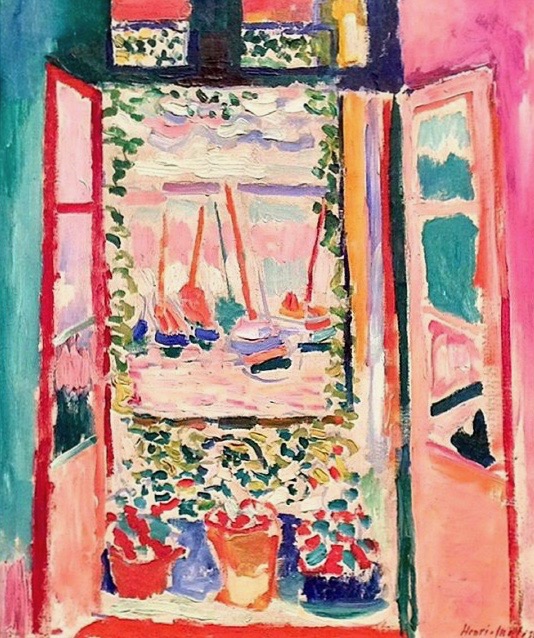
In 1912 Bonnard bought a painting by Henri Matisse, The Open Window at Collioure (1905). Matisse would soon emerge as one of the leading figures of modern painting, but the two were also friends, maintaining a lively correspondence over several decades. And one can see what inspired Bonnard to make this purchase: doors and windows appear continually in his own work, allowing interior space to be animated by the vitality of the outside world.

•-Open-Window-Collioure-1905-by-Henri-Matisse-•-Henri-Matisse-painted-Open-Window-Collioure-in-t
Henri Matisse, “The Open Window at Collioure” (1905). Oil paint on canvas. National Gallery of Art, Washington
Pierre Bonnard L'atelier au mimosa 1939-46 Musée National d'Art Moderne - Centre Pompidou (Paris, France)
Pierre Bonnard, “The Studio with Mimosas” (1939-46). Oil paint on canvas. Musée National d’Art Moderne – Centre Pompidou, Paris.

More revealing, though, are the differences we can glean from The Open Window at Collioure. Matisse’s painting, with its flat blocks of garish colour, is straining towards abstraction. As a formal device, the window merely facilitates a jigsaw of squares and rectangles. Such spatial deconstruction and pictorial simplification were intrinsic to the general direction of modernism at this time. This, however, was the direction from which the patient and meticulous Bonnard had partly stepped aside. For he remained under the influence of impressionist painting, which emphasised the subtlety and fluidity of light and colour as a means of capturing the immediacy of sensory experience. Thus, as Juliette Rizzi notes, Bonnard’s use of “framing devices such as doors, mirrors, and horizontal and vertical lines” allow him a compromise of sorts. They do not simplify his paintings so much as provide an angular scaffolding around which he can weave his nebulous imagery.

The window and its slanted rectangles of light are crucial to the strange drama of The Bowl of Milk. Formally, this element occupies the very centre of the composition, holding it in place. But it is also a source of ambiguity. The window is seemingly a portal to another world, flooding the room with uncanny energy. The woman appears stiff, frozen at the edge of a spotlight. It’s as though the scene has been illuminated just briefly – before being buried in darkness again.

Testing the limits of universalism in science

This essay was first published by Areo magazine on 23 November 2018. 

Science traditionally aspires to be universal in two respects. First, it seeks fundamental knowledge—facts which are universally true. Second, it aims to be impersonal in practice; identity should be irrelevant to the process by which a scientific claim is judged.

Since the era following the Second World War, a great deal has come to rest on these aspirations. For not only does universalism make science a reliable means of understanding the world; it also makes scientific institutions an obvious basis for cooperation in response to various grim and complex challenges facing humanity. Today, these challenges include environmental damage, infectious diseases, biotechnology and food and energy insecurity. Surely, if anyone can rise above conflicts of culture and interest—and maybe even help governments do the same—it is the people in the proverbial white coats.

And yet, lately we find the very principle of universalism being called into doubt. Armed with the tools of critical theory, scholars in the social sciences and humanities assert that science is just one knowledge system among many, relative to the western context in which it evolved. In this view, the universalism that enables science to inform other peoples and cultures is really a form of unjust hegemony.

So far, this trend has mostly been discussed in an educational setting, where there have been calls to decolonize scientific curricula and to address demographic imbalances among students. But how will it affect those institutions seeking to foster scientific collaboration on critical policy issues?

An argument erupted this year in the field of ecology, centered on a body called the IPBES (Intergovernmental Panel on Biodiversity and Ecosystem Services). I suspect few readers have heard of this organization, but then, such is the unglamorous business of saving the world. The IPBES is one of the few vehicles for drawing governments’ attention to the rapid global decline of biodiversity, and of animal and plant populations generally.

In January, leading members of the panel published an article in the journal Science, announcing a “paradigm shift” in how it would approach its mission. They claim the scientific model on which the IPBES was founded is “dominated by knowledge from the natural sciences and economics,” and prone to adopt the “generalizing perspective” of “western science.” Consequently, they argue, it does not provide space for the humanities and social sciences, nor does it recognize the knowledge and values of local and indigenous peoples.

The article, which sparked an acrimonious row within the research community, came after several years in which IPBES papers and reports had developed “a pluralistic approach to recognizing the diversity of values.” The panel has now officially adopted a new paradigm that “resist[s] the scientific goal of attaining a universally applicable schema,” while seeking to “overcome existing power asymmetries between western science and local and indigenous knowledge, and among different disciplines within western science.”


Science, Policy, Politics

 It is easy to dismiss such terminology as mere jargon, and that is what some critics have done. They claim the “paradigm shift” amounts to “a political compromise, and not a new scientific concept.” In other words, labeling a universal outlook western science is a diplomatic gesture to placate skeptics. Recognizing “a diversity of values” does not alter the pertinent data, because, however you frame them, the data are the data.

But here is the problem. When it comes to organizations whose role is to inform policy, this neat separation between science and politics is misleading; they often have their own political goals that guide their scientific activity. For the IPBES, that goal is persuading policymakers to conserve the natural world. Consequently, the panel does not merely gather data about the health of ecosystems. It gathers data showing how humans benefit from healthy ecosystems, so as to emphasize the costs of not conserving them.

This strategy, however, forces the IPBES to make value judgments which are not straightforwardly amenable to scientific methods. To assess the benefits of nature, one must consider not just clean air and soil nutrients, but also nonmaterial factors such as religious inspiration and cultural identity that vary widely around the world. Can all of this really be incorporated into a universal, objective system of measurements?

The IPBES’ original paradigm tried to do so, but, inevitably, the result was a crude framework of utilitarian metrics. It sought to categorize and quantify all of nature’s benefits (including the religious and cultural) and convert them into monetary values—this being, after all, the language policy makers understand best. As the Science article states, drawing on a substantial literature, this reductive approach alienated a great many scientists, as well as local people, whose participation is crucial for conservation.

All of this illustrates some general problems with universalism as a basis for cooperation. Firstly, when a scientific institution directs its work towards certain policy outcomes, its claims to objectivity become more questionable. It might still produce knowledge that is universally true; but which knowledge it actually seeks, and how it translates that knowledge into policy tools are more contentious questions.

This problem arises even in cases of solid scientific consensus, such as climate change. Rising temperatures are one thing, but which consequences should scientists investigate to grab the attention of policymakers or even voters? Which economic policies should they endorse? Such judgments will inevitably be political and ideological in nature.

Moreover, some subjects are simply more politically and culturally contentious than others. There are many areas where, even if a universalist approach can be devised, it will nonetheless be regarded as an unwelcome and foreign way of thinking. As we have seen, nature is one of these areas. Another obvious example is gene editing, which Japan has recently allowed in human embryos. Any attempts to regulate this technology will likely require a debate about religious and cultural mores as much as hard science.


The Limits of Pluralism

The question is, however, does the pluralism now advocated by IPBES offer a viable solution to these problems? It is highly doubtful. The influence of critical theory, as seen in a fixation with knowledge as a proxy for power, is itself antithetical to productive cooperation. Rather than merely identifying the practical limitations of the scientific worldview, it pits science in zero-sum competition with other perspectives.

The problem begins with a slide from cultural pluralism into epistemological relativism. In the literature that laid the groundwork for the IPBES “paradigm shift,” knowledge systems are treated as “context specific,” each containing “its own processes of validity.” As a result, the prospect of compromise recedes into the distance, the priority being to “equitably bridge different value systems, eventually allowing processes of social learning.”

As critics have warned, there is a danger here of losing clarity and focus, leading to less effective advocacy. IPBES papers and reports now bulge with extensive discussions of cultural particularism and equity, threatening at times to become an altogether parallel mission. Yet in 2016, when the panel delivered its most comprehensive assessment to date, the summary for policymakers included barely any information about the economic costs of ecological damage.

Indeed, despite its supposed skepticism, there is an air of fantasy surrounding this discourse. Even if there are areas where it is inappropriate to impose a purely scientific outlook, it is disingenuous to pretend that, with a particular goal in view, all perspectives are equally useful. Likewise, no amount of consultation and mediation can negate the reality that, with limited resources, different values and interests must be traded off against one another. If scientists absolve themselves of this responsibility, they simply pass it on to policymakers.

Universalism has practical limits of its own: it cannot dissolve cultural differences, or remove the need to make political decisions. But, provided such limitations are understood, it surely remains the most useful default principle for collaborative work. Even diverse institutions need common goals: to treat values as fully incommensurable is to invite paralysis. And to politicize knowledge itself is to risk unraveling the scientific enterprise altogether.

Yuval Noah Harari’s half-baked guide to the 21st century

This review was first published by Arc Digital on 25 October 2018.

There is something immensely comforting about Yuval Noah Harari. In an era when a writer’s success often depends on a willingness to provoke, Harari’s calling cards are politeness and equanimity. In the new class of so-called “rock star intellectuals,” he is analogous to Coldplay: accessible, inoffensive, and astoundingly popular. I find no other writer so frequently referenced by friends who don’t generally read. On YouTube he is a man for all seasons, discussing #MeToo with Natalie Portman, contemplating the nature of money with Christine Lagarde, and considering “Who Really Runs the World?” with Russell Brand.

Harari, a historian at the Hebrew University of Jerusalem, is by no means undeserving of this success. His first book, Sapiens: A Brief History of Humankind, displayed a rare talent for condensing vast epochs of history into simple narratives. In his second, Homo Deus, he showed all the imagination of a science fiction writer in presenting the dystopian possibilities of artificial intelligence and biotechnology.

But now Harari has abandoned the speculative realms of past and future, turning his attention to the thorny problems of the present. And here we find that his formula has its limits. 21 Lessons for the 21st Century is a collection of essays taking on everything from culture and politics to technology and spirituality. Undoubtedly, it offers plenty of thought-provoking questions and insights. By and large though, the very thing that made his previous works so engaging — an insistence on painting in broad, simple brushstrokes — makes this latest effort somewhat superficial.

Many of Harari’s essays are just not very illuminating. They circle their subjects ponderously, never quite making contact. Take his chapter on the immigration debate in Europe. Harari begins by identifying three areas of disagreement: borders, integration, and citizenship. Then he walks us through some generic and largely hypothetical pro- and anti-immigration stances, guided mainly by a desire not to offend anyone. Finally, after explaining that “culturism” is not the same as racism, he simply concludes: “If the European project fails…it would indicate that belief in the liberal values of freedom and tolerance is not enough to resolve the cultural conflicts of the world.”

Here we glimpse one of the book’s main questions: whether liberalism can unite the world and overcome the existential challenges facing humanity. But what is liberalism? According to Harari, all social systems, whether religious or political, are “stories.” By this he means that they are psychological software packages, allowing large-scale cooperation while providing individuals with identity and purpose. Thus, liberalism is a “global story” which boils down to the belief that “all authority ultimately stems from the free will of individual humans.” Harari gives us three handy axioms: “the voter knows best,” “the customer is always right,” and “follow your heart.”

This certainly makes matters crystal clear. But political systems are not just ideological dogmas to which entire populations blindly subscribe. They are institutional arrangements shaped by the clashes and compromises of differing values and interests. Historically, liberalism’s commitment to individualism was less important than its preference for democratic means to resolve such conflicts. Harari’s individualist, universalist liberalism has certainly been espoused in recent decades; but as a more perceptive critic such as John Gray or Shadi Hamid would point out, it is only for sections of Western society that this has offered a meaningful worldview.

Overlooking this basic degree of complexity leads Harari to some bizarre judgments. He claims that “most people who voted for Trump and Brexit didn’t reject the liberal package in its entirety — they lost faith mainly in its globalizing part.” Does he really think these voters were once enthusiastic about globalism? Likewise, to illustrate the irrational character of liberal customs, Harari states: “If democracy were a matter of rational decision-making, there would be absolutely no reason to give all people equal voting rights.” Did he not consider that a key purpose of the ballot is to secure the legitimacy of government?

Harari is frequently half-sighted, struggling to acknowledge that phenomena can have more than one explanation. I confess I chuckled at his reading of Ex Machina, the 2015 sci-fi about a cyborg femme fatale.“This is not a movie about the human fear of intelligent robots,” he writes. It is about “the male fear…that female liberation might lead to female domination.” To support his interpretation, Harari poses a question: “For why on earth would an AI have a sexual or a gender identity?” This in a book which argues extensively that artificial intelligence will be used to exploit human desires.

Nor are such hiccups merely incidental. Rather, they stem from Harari’s failure to connect his various arguments into a coherent world-view. This is perhaps the most serious shortcoming of 21 Lessons. Reading this book is like watching a one-man kabuki play, whereby Harari puts on different masks as the situation demands. But these characters are not called on to complement each other so much as to prevent the stage from collapsing.

We have already encountered Harari’s first mask: postmodern cynicism. He is at pains to deconstruct the grand narratives of the past, whether religious, political, or national. He argues that the human subject, too, is a social construct — an amalgam of fictions, bound by context and largely incapable of rational thought.

However this approach tends to invite relativism and apathy. And so, to provide some moral ballast, Harari picks up the mask of secularist polemic. Though never abandoning his light-hearted tone, he spends a great deal of time eye-poking and shin-kicking any tradition that indulges the human inclination for sanctity, ritual, and transcendence. But not to worry: you can keep your superstitions, “provided you adhere to the secular ethical code.” This consists of truth, compassion, equality, freedom, courage, and responsibility.

What, then, of our darker impulses? And what of our yearning to identify with something larger than ourselves? Enter Harari in his third mask: neo-Buddhist introspection. This is an especially useful guise, for whenever Harari encounters a difficult knot, he simply cuts it with a platitude. “If you really understand how an action causes unnecessary suffering to yourself and to others,” he writes, “you will naturally abstain from it.” Moreover: “If you really know the truth about yourself and the world, nothing can make you miserable.”

I am not saying these outlooks cannot be reconciled. My point is that Harari does not attempt to do so, leaving us instead with an array of loose ends. If the imperative is to deconstruct, why should secular shibboleths be left standing? Why should we worry about technology treating us as “little more than biochemical algorithms,” when Harari already thinks that “your core identity is a complex illusion created by neural networks”? And given that “both the ‘self’ and freedom are mythological chimeras,” what does Harari mean when he advises us to “work very hard…to know what you are, and what you want from life”?

You might object that I’m being ungenerous; that the most popular of popular intellectuals must necessarily deal in outlines, not details. But this is a slippery slope that leads to lazy assumptions about the incuriousness of a general audience. When it comes to current political and philosophical dilemmas, being a good popularizer does not consist in doling out reductive formulas. It consists in giving a flavor of the subtlety which makes these matters worth exploring. In that respect, 21 Lessons falls short of the mark.